
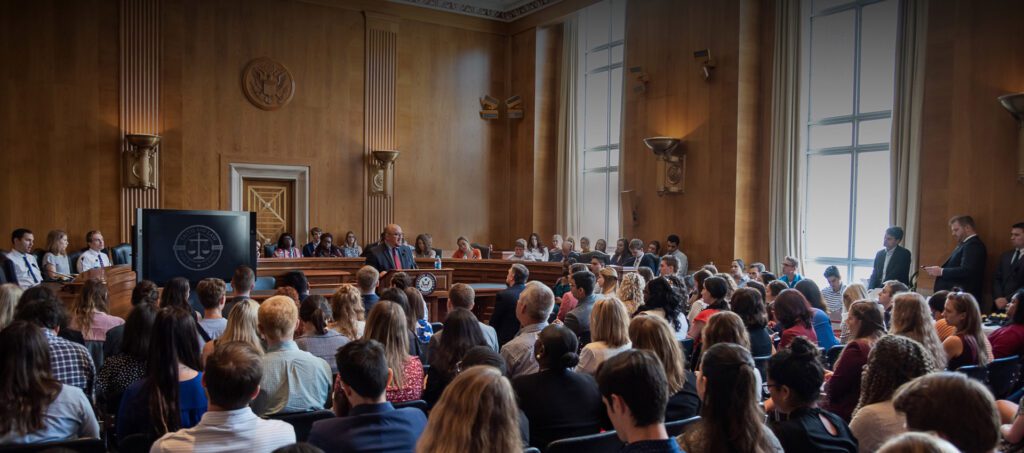
In December, at the end of last year (2024), I had the great opportunity to talk with Congressional staffers on “Understanding Violent Crime and the Policy Responses.” The lunch conversation was hosted by Faith and Law in partnership with Prison Fellowship.
The conversation was excellent. One of the things I appreciated most was having a chance to share a personal reflection as to how I came to this work – working on public safety and criminal justice – through my Faith. My first political “action” so-to-speak was as part of my Evangelical church’s youth group in Delaware. Delaware at the time conducted state executions and our youth group held vigils outside the state prison on two cold winter nights when executions took place. It was a chilling (literally and figuratively) experience that challenged and provoked my own reflections and searching on what it means to live my Christian Faith.
Beyond my personal journey to this work, I made several points:
- The core function of government is to keep it’s people safe. Preventing and solving crimes is paramount to this function. However, crime solving and clearances remain depressingly low – about 50% for homicides (essentially a coin flip) and for property crimes as low as 10%.
- Violent crime in America is a racial justice issues. Black people are disproportionately affected by violent crime and Black victims of violent crime are less likely to have their cases solved. The criminal justice system must work properly for all Americans – this also helps build trust and faith in our public institutions.
- These are moral issues. Behind every statistic is a person, a family, a community. We must engage in thoughtful dialogue with a shared commitment to justice and what works.
- One thing we can do is collect better data. It is embarrassing that I can tell you how many hogs were slaughtered last week across the U.S., but not how many crimes were committed.
- We know that more police can reduce crime, particularly violent crime. What matters especially is how they are used. Hot spot and problem-oriented policing strategies can increase the crime prevention effect. Importantly, this is driven by deterrence rather than arrest, which could help reduce mass incarceration as well.
- We need to make sure law enforcement has the resources needed to investigate and solve crimes effectively, that there is accountability and transparency in policing practices, and that we invest in innovation in policing and rigorously evaluate the effects.
 Marc Krupanski